Designed to be found. Written to be chosen.
Content Marketing SEO & AI Search
Writing & Multimedia
I build search-optimized content systems, local SEO, and multi‑channel creative that help businesses show up at the top of Google, get named in AI answers, and turn that attention into leads.

Portfolio
Search. Copy. Design. Systems.
Real projects, start to finish: what I noticed, what I made, and what I learned.
Showing:
Local SEO PR & Content Short-Form Video
Getting a Local Business Found, and Trusted
-
Top 3:
Google map results for most of the key local searches we targeted
-
7 to 27 or more:
new Google reviews, the year before vs. after the review funnel
-
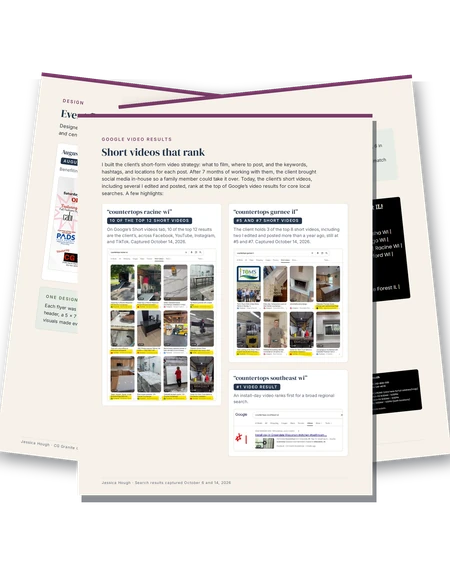
10 of 12:
top Google short videos for “countertops racine wi”
What I noticed
CG Granite Countertops, a fabricator with two showrooms, wanted more leads in the towns they were targeting. Their website and Google listings undersold them. Services and service areas were unclear, business details didn’t match across key sites, and few trusted sources mentioned them.
What I made
- Search: homepage copy, 7 new location pages, FAQ pages, cleaner navigation, and the site’s first footer listing both locations
- Google profiles: optimized and managed both Business Profiles, corrected listings on other key sites, and added photos I took on-site
- Social and video: recommended a shift toward Reels, Stories, and Shorts while keeping photos in the mix, edited the client’s footage, and optimized the copy on every video and photo post for search
- Reviews: a QR-code thank-you card and landing page that made reviewing easy, plus replies to customer reviews
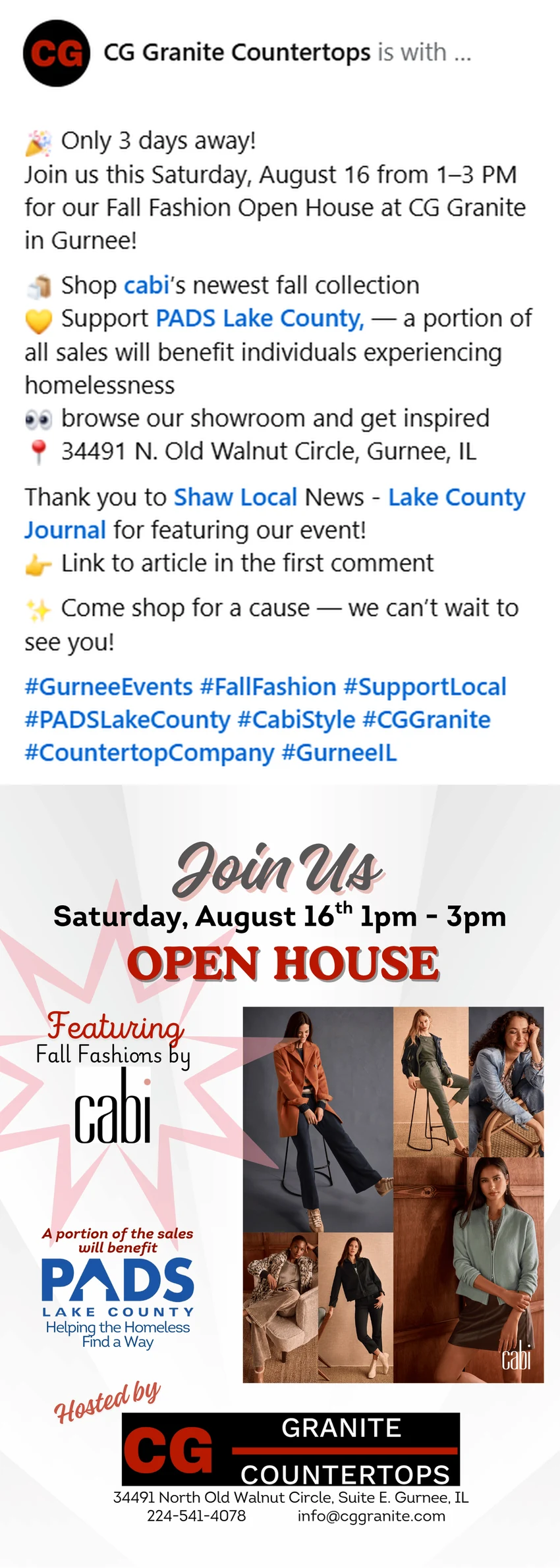
- PR and events: three charity-event campaigns with press releases, event pages, and graphics, all covered by local news
- Leads: a “Get a Quote” button on key pages and a rebuilt quote form that captures project location, measurements, and lead source
Result
As well as the numbers above, in October 2026, before the site was rebuilt, Google’s AI Mode named the client in answers about their main services, often first.
ToolsGoogle Business Profile · Google Search Console · YouTube Studio · HighLevel · WordPress · Canva · Facebook · Instagram
What I learned
Local search and AI recommendations start from the same foundation: accurate listings, clear pages, and mentions from trusted sites. AI just weighs those outside sources far more heavily. A business’s own website is becoming the last stop, where customers confirm a choice AI has already helped them make.
Another agency has since rebuilt the client’s website. My role was content, not development. Screenshots of my versions are in the case study.
AEO/GEO Strategy System Design Report Design
An AI Visibility Audit System for Local Businesses
What I noticed
As AI search starts to replace traditional search, more people are asking ChatGPT, Gemini, and Google’s AI which local business to call. Most owners have no idea whether those tools can find them, let alone recommend them. I wanted a clear, practical way to answer that.
What I made
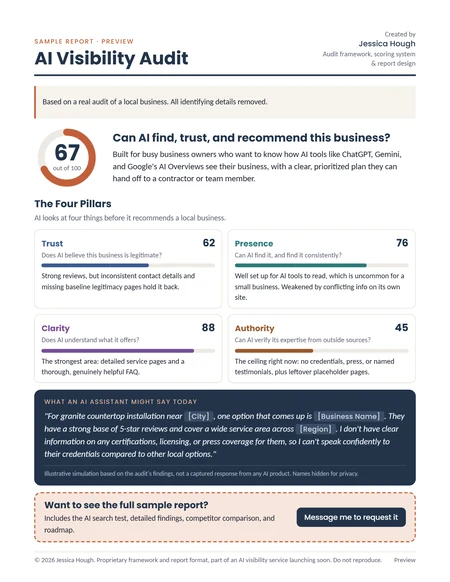
An audit system that shows how visible a local business is to AI search. It uses Google’s APIs to confirm the right business and Google Business Profile. Then it pulls 40+ signals from the business’s own assets, like its website and Google profile, and from third-party sites that mention it. AI looks at many of the same things traditional SEO does, but it weighs some signals differently, so I sorted them into four pillars, Trust, Presence, Clarity, and Authority, and weighted each one based on my research into how AI decides which businesses to recommend. The findings become a plain-English, prioritized action plan an owner can hand off to a team member or contractor.
How I built it
I started with research: digging into how AI tools find, evaluate, and choose which businesses to recommend, and where that differs from traditional search. From there, I designed the framework, the weighting, and the report myself, then built the research workflow in Claude, with web search and data-extraction connectors plus Google’s APIs. I’ve tested it on several real local businesses so far, running real customer questions through ChatGPT, Gemini, Perplexity, and Google AI Mode, and I’m still testing and refining it.
ToolsClaude, with web search and data-extraction connectors · Google APIs · Tested in ChatGPT, Gemini, Perplexity, and Google AI Mode
What I learned
AI tools reward the same things people do: clear, consistent, trustworthy information. The difference is that AI actually checks, comparing a business’s details far more carefully than most people ever would.
Interactive Tool Conversion Copy AI Prototyping
The True Cost Calculator: Turning Fuzzy Guesses into Clear Numbers
What I noticed
When I asked small business owners what a manual task was costing them, the answer was usually a shrug and a wide range: “Somewhere between 5 and 20 hours a week.” (I was doing the same thing with my own time.) You can’t make a smart decision on a guess.
What I made
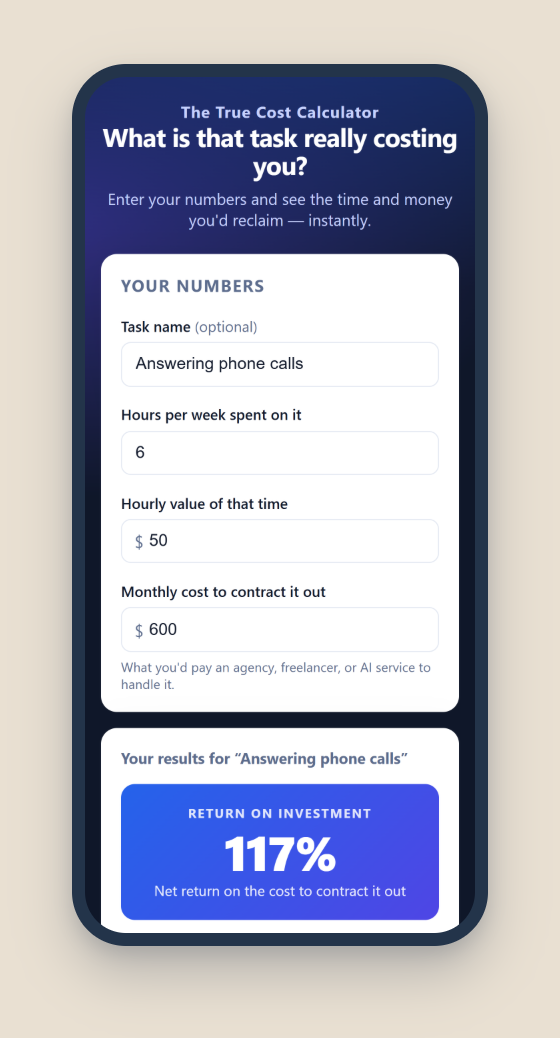
A simple interactive calculator that walks an owner through their own numbers until that fuzzy range becomes a concrete net ROI figure. I wrote the copy, designed the experience, and built it with Claude Code.
ToolsClaude Code · Vercel
What I learned
How to take an idea all the way to a live web app. I built it with Claude Code and published it on Vercel, so anyone can open it from a link and see their own numbers in seconds. I also learned how much the words matter. Owners always ask what something new will cost, but rarely what their current way of doing things is costing them. I named it the True Cost Calculator to put that second question first. Small swaps count too: “contract out” landed better than “outsource,” which can sound like replacing someone.
Launch post: 590 impressions 397 members reached 80% outside my network (as of Oct 2026)
Content Strategy Original Research AEO
Google’s AI Is Now Phoning Local Shops for Quotes
About 2,100 words 9-minute read 9 sources (5 from Google) 6-question FAQ
Audience
Owners of small and mid-size local service businesses who rely on local search for leads.
What I noticed
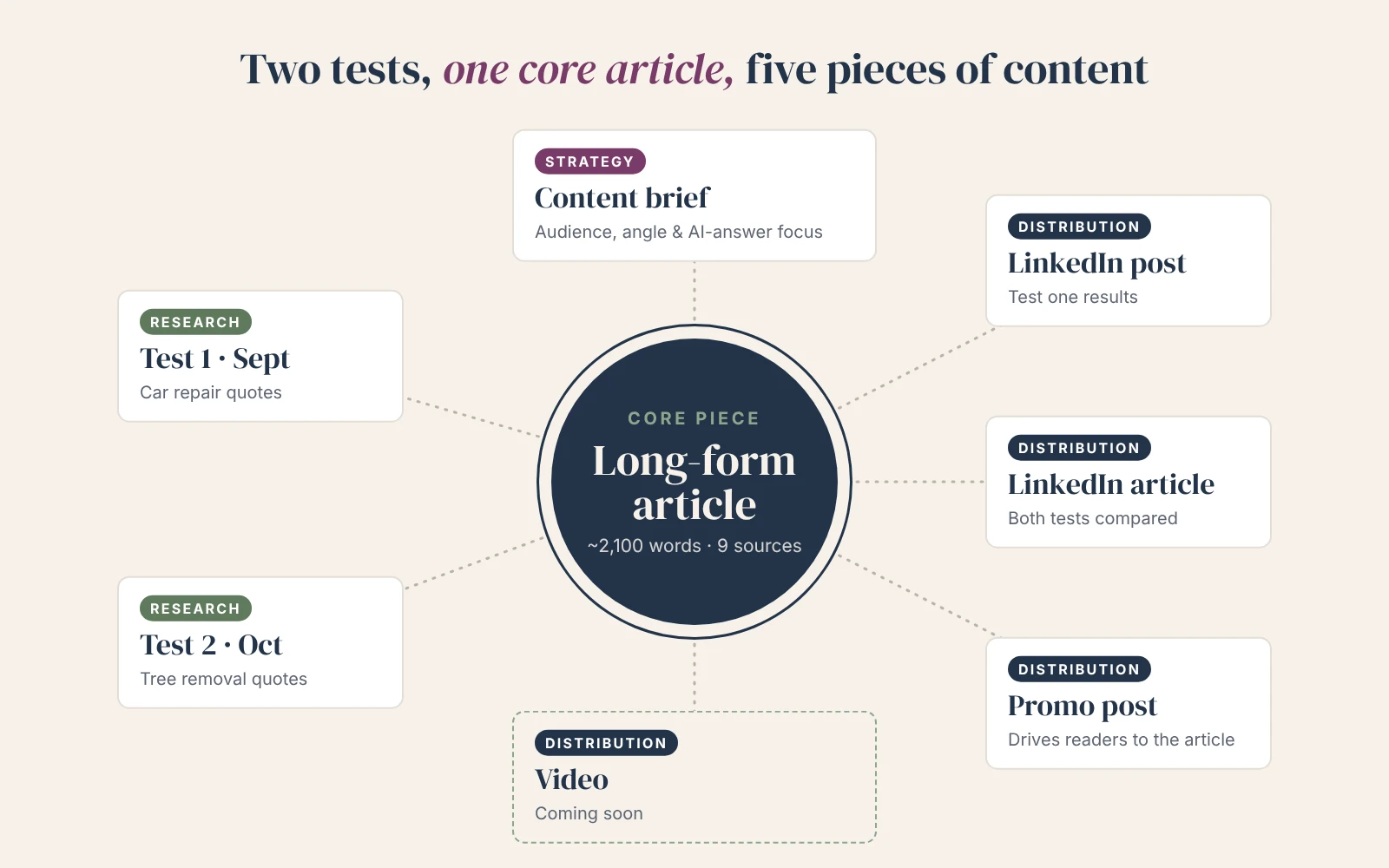
When Google started phoning local shops for quotes, I tested it twice: a car repair in September and a tree removal in October. The results were very different. I built one core article around the questions owners ask, written for Google and AI search, then turned it into pieces for LinkedIn.
What I made
- Content brief (PDF)
- Long-form article (PDF), the core piece
- LinkedIn post: test one results
- LinkedIn article: both tests compared. A shorter version written for LinkedIn, comparing the two tests side by side.
- Promo post for the article
- Video (coming soon)
ToolsGoogle AI Mode · Claude · Canva · LinkedIn
AI noteI ran both tests and gathered the sources, drafted with Claude, and edited in my own voice.
What I learned
Google calls when it can’t find the answer online. In the second test, a company with prices on its website got recommended before the calls were even finished. That changed my advice from “answer your phone” to “publish your prices.”
Writing Samples
Words, on the page.
Articles, essays, and features that show how I research, interview, and write.
-
Google’s AI Is Now Phoning Local Shops for Quotes
Original Research Article AEO
A long-form article built on two live tests of Google’s AI calling local shops for price quotes, with practical steps for owners on what to publish so they’re ready. About 2,100 words, with 9 sources and a 6-question FAQ.
ToolsGoogle AI Mode · Claude · Canva
StyleAP
Read the article (PDF) Read the shorter LinkedIn version See the full projectAI Search Writing -
Harvest Over Halloween
Storytelling Personal Essay About 1,100 Words
In middle school, I spent an entire day as a bag of jelly beans. Years later, one hard autumn changed how I see the whole season.
ToolsClaude · Canva AI
StyleChicago Manual of Style
AI noteWritten by me, in my own words. Structure and line edits with help from Claude, an AI assistant. Image created with Claude and Canva AI.
Read the essayWriting -
Brewing More Than Coffee at King’s Cup Cafe
Business Profile About 600 Words Interview & Photography
A feature on a local cafe owner, built from an in-person interview and told in her own words. Interview, writing, and photos by me. Published on a local community news site I created, 2024.
ToolsWordPress · ChatGPT · Claude
StyleAP
AI noteI did the interview and took the photos, drafted with ChatGPT from my notes, and edited in my own voice. AP style edits with help from Claude.
Read the profile (PDF)Writing -
The Woman With the Laugh
Human Interest Feature Community Tribute Forthcoming
A personal tribute to a woman remembered for her unforgettable laugh, her honesty about life’s hard seasons, and her deep love for her hometown. Woven from shared memories, her own published words, and the people who gathered to honor her.
ToolsClaude
AI noteThe memories and research are mine. Claude drafted from my notes and my direction on tone and length, and I edited it in my own voice.
Not yet published. Shared privately while the family reviews it. Full sample available on request.
Request this sampleWriting -
Local PR & Event Campaigns for CG Granite Countertops
Press Releases Community Events 2025–2026
I wrote the press releases for three community events, each benefiting a nonprofit. The Lake County Journal ran all three as news stories, with additional coverage in Lake County News Dispatch and the Daily Herald.
ToolsChatGPT (custom GPT for press releases)
AI noteDrafted with a custom GPT for press releases, then edited in the client’s voice.
Read a press release as submitted (PDF)- August 2025 open house: Lake County Journal
- November 2025 open house: Lake County Journal Lake County News Dispatch
- Spring pop-up (Feb 2026): Lake County Journal Daily Herald
Writing PR & Media
Video & Audio
Words, in motion.
Short-form video and audio I’ve edited, optimized, and directed, with AI tools labeled wherever I used them.
YouTube strategy Channel setup
YouTube SEO: setting up a channel to be found
Before this, the client’s channel had one 4-minute intro video and two short horizontal clips, posted with no descriptions or tags. YouTube Shorts became one part of a wider shift toward short-form video, so I set the channel up for search and consistency:
- A header banner designed to read well on every screen, plus the client’s logo as the channel icon
- A rewritten channel summary
- Saved upload defaults: a keyword- and location-rich description and tags that apply to every new video
- End cards with graphics and text I designed in Canva on later Shorts
- Audio editing and music on every Short except the first. On that one, the original sound was the hook, so I left it as is.
ToolsYouTube Studio · Canva
Short-form video Edited & search-optimized
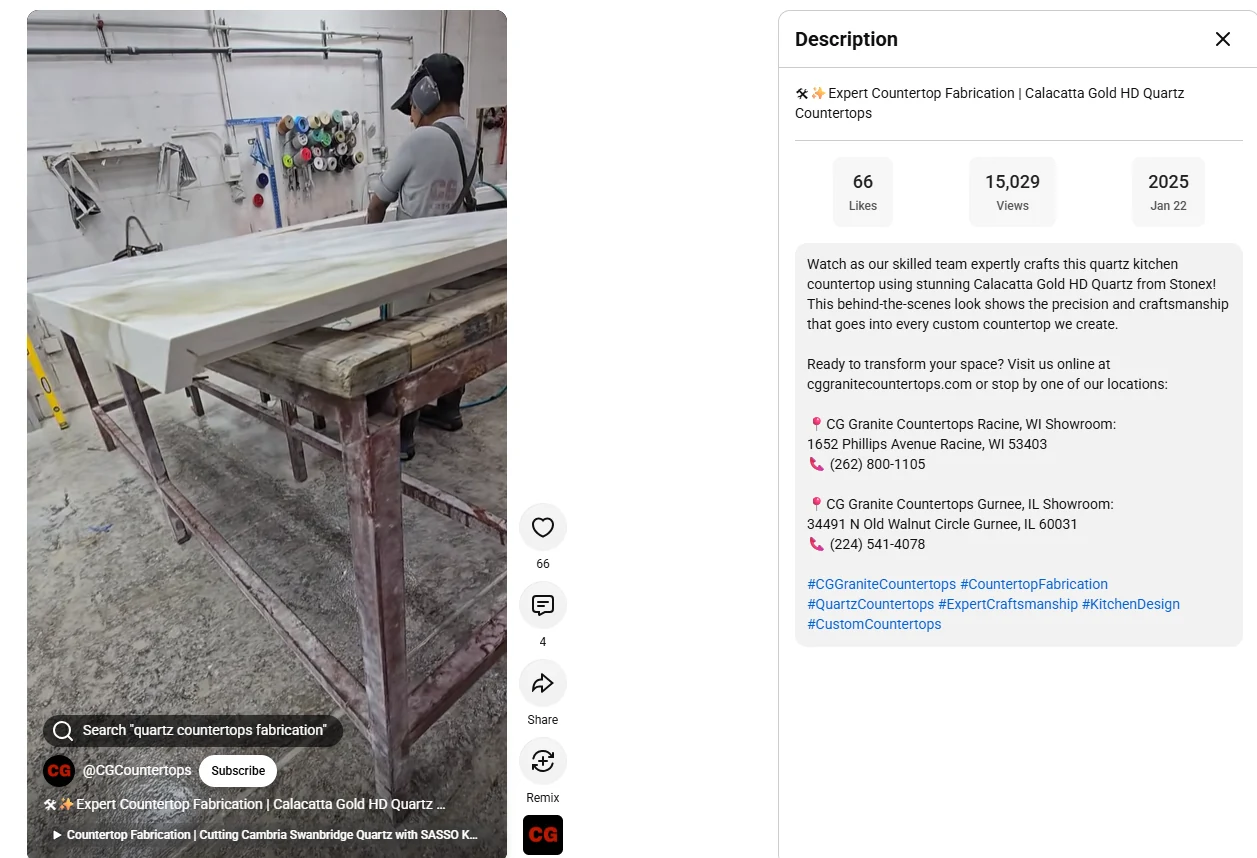
The first Short: 15,000+ views
The first YouTube Short after I recommended the move to short-form video: 15,000+ views (as of Oct 2026). The client supplied the footage. I trimmed it, posted it to YouTube, Facebook, and Instagram, and optimized each post for search with a keyword-focused title, description, hashtags, and both showroom locations. I kept the raw saw sound as the hook.
ToolsYouTube Studio · Canva
Design & Social
Made for real clients. Print, social, and on-site.
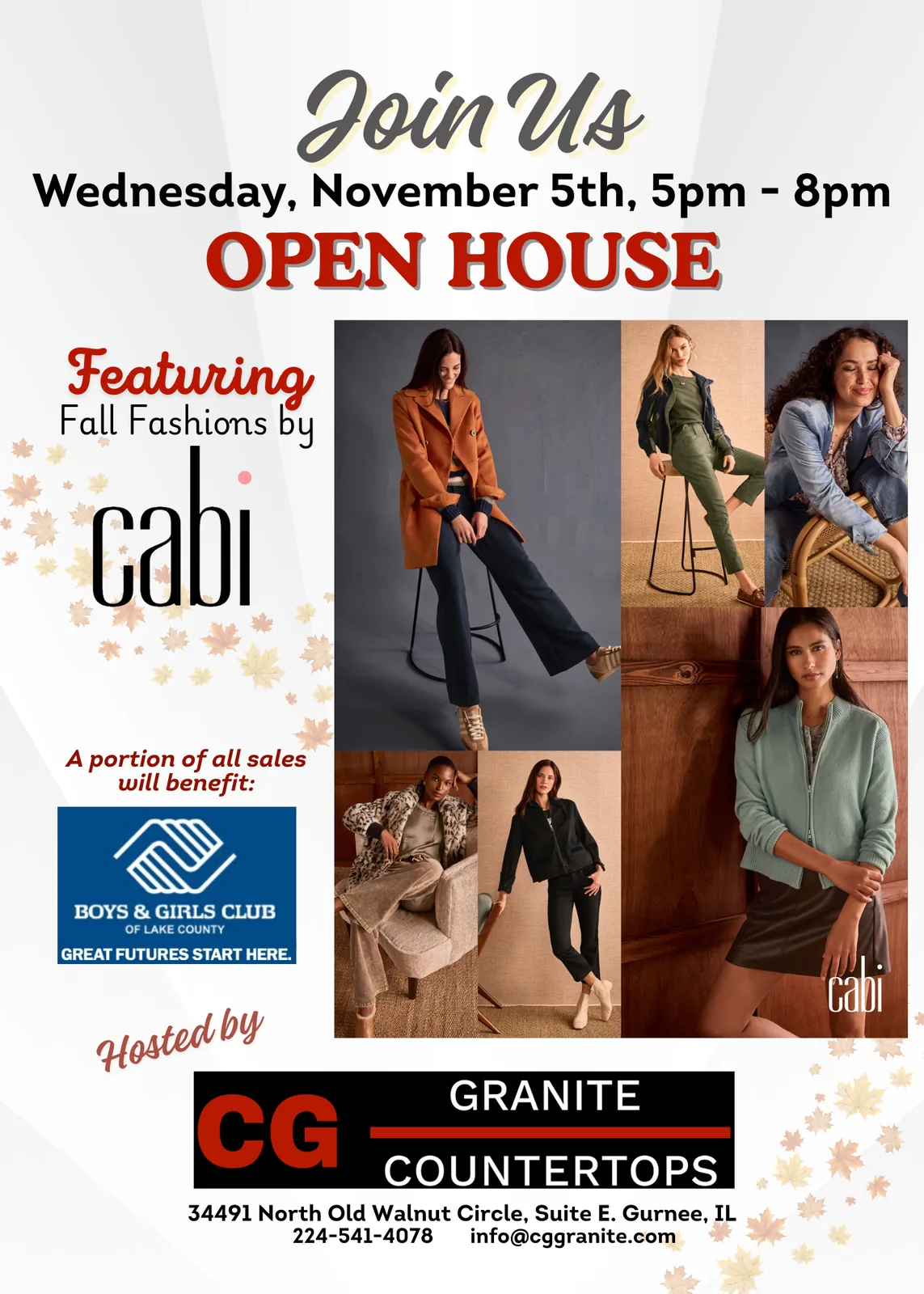



One event system, three charity events
A reusable event design for three charity fashion events, adapted for each season, partner, and nonprofit, in print/email and social formats. Each event was covered by local news.
ToolsCanva
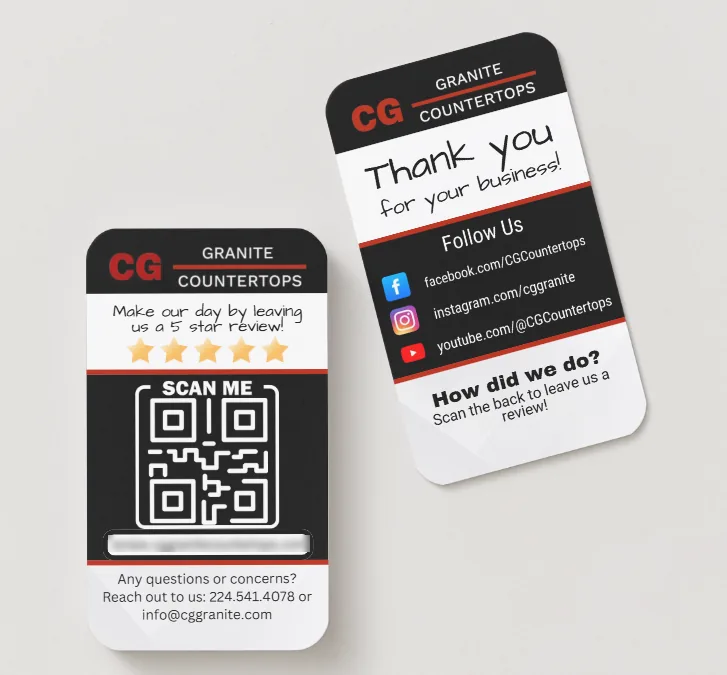


Thank-you cards that asked for reviews
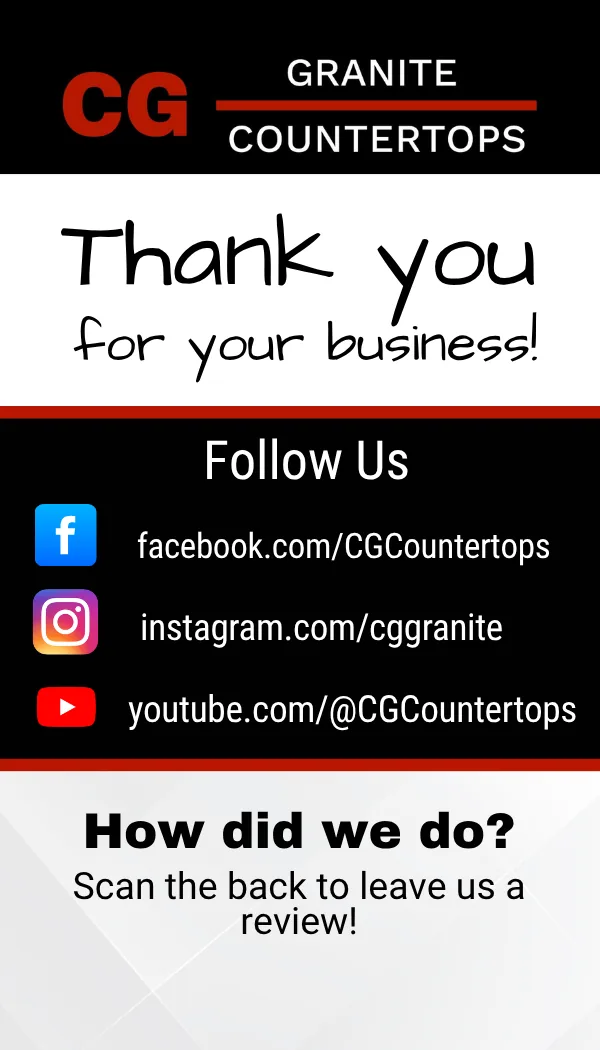
Thank-you cards with a QR code that sent customers to leave a Google review. New Google reviews nearly quadrupled: 7 in the 12 months before, 27+ in the 12 months after, across both locations.
ToolsCanva

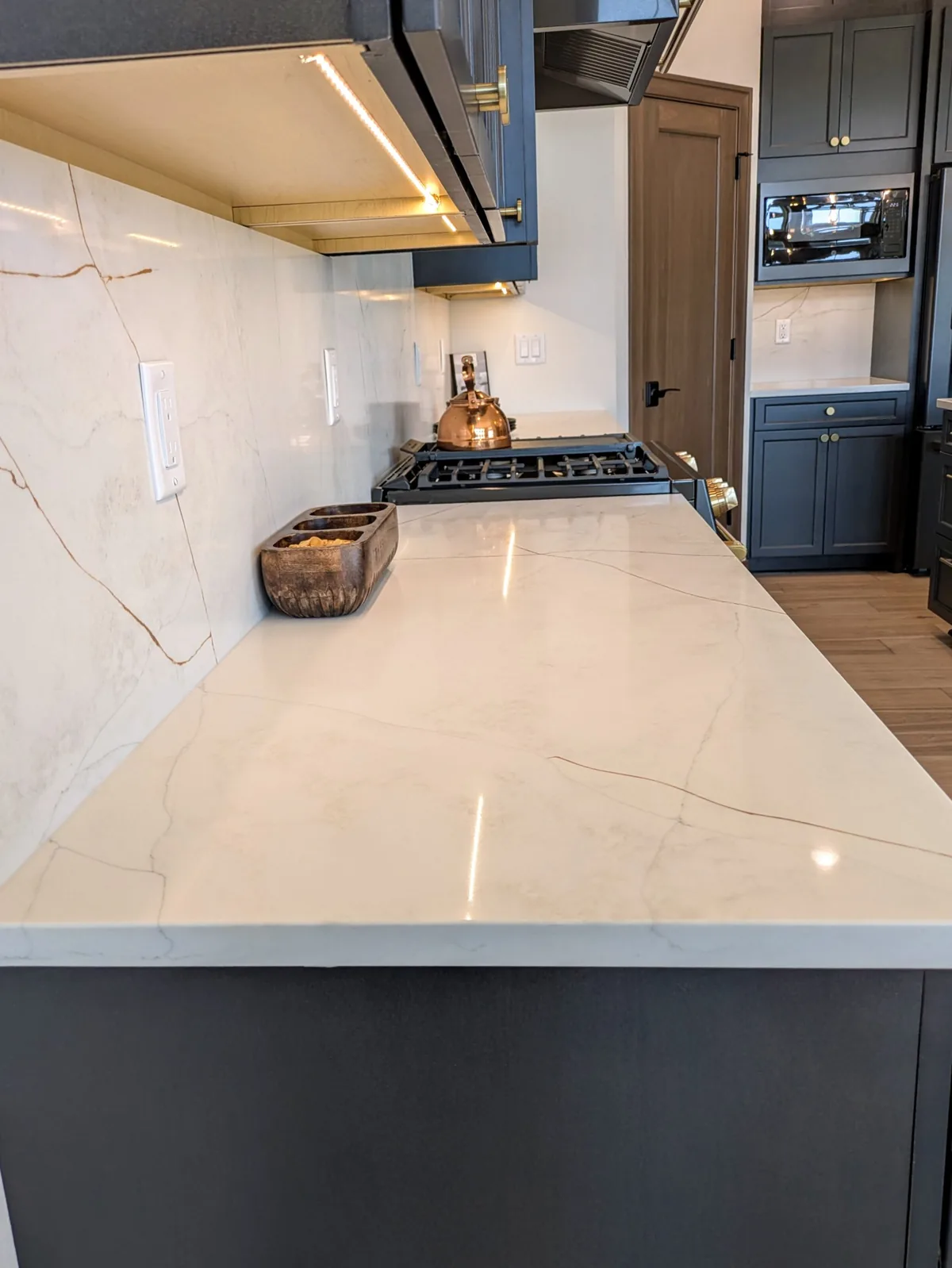
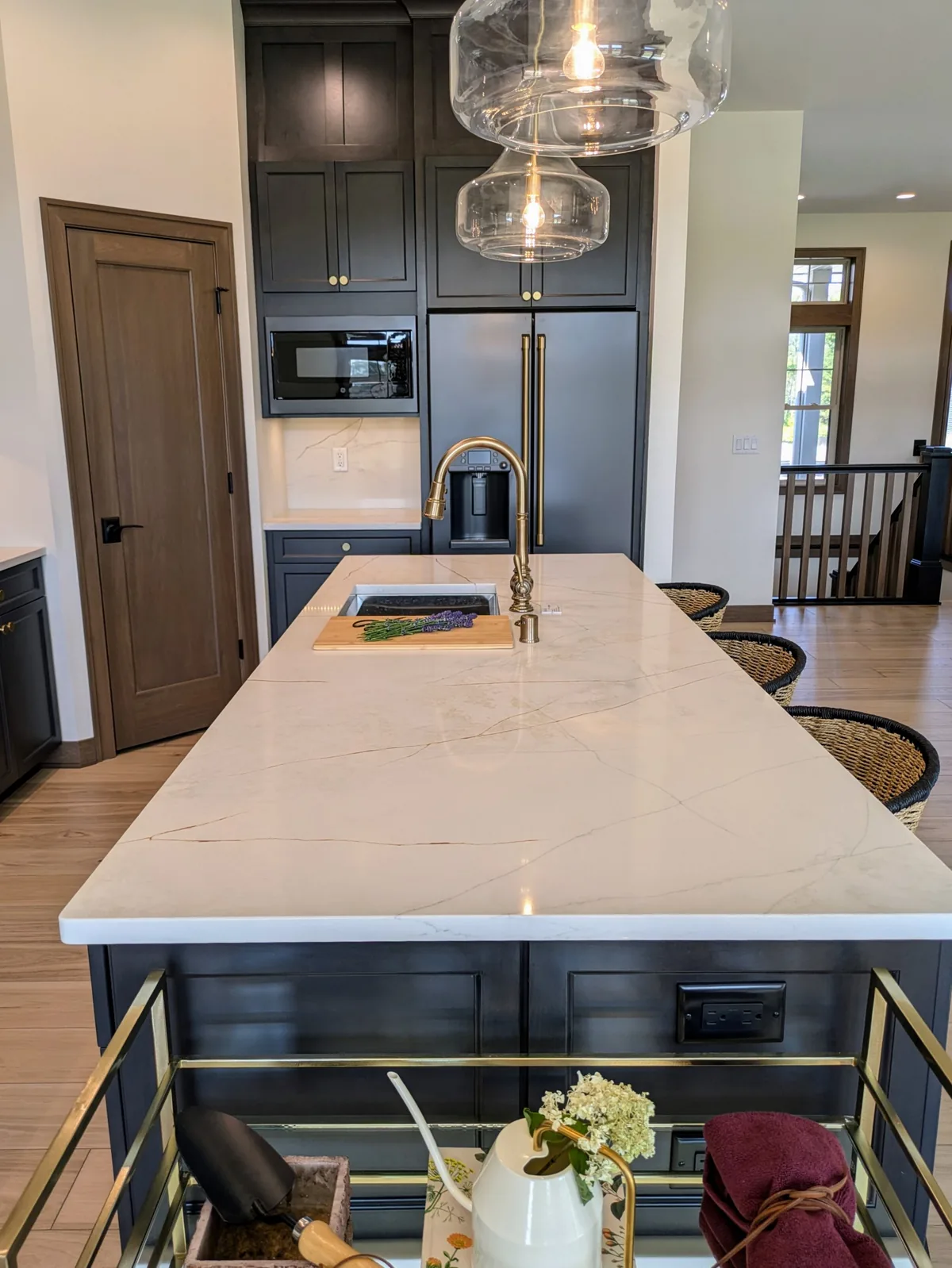
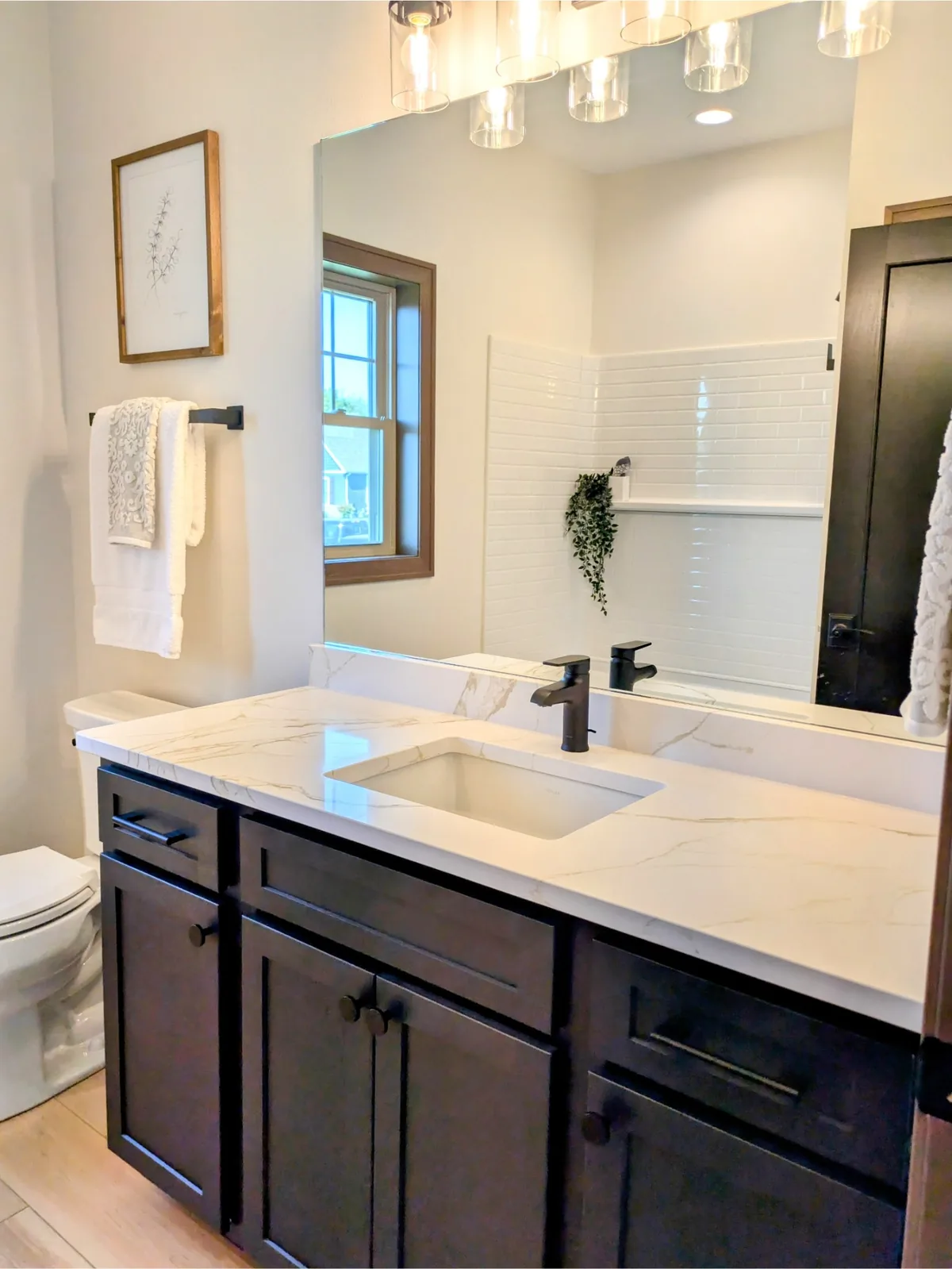
On-site at the Parade of Homes
Photos I took at the 2024 Parade of Homes, where the client’s countertops were featured in a showcase home. My main kitchen photo shows the quartz countertops with a matching full-height backsplash. Since the fall of 2024, it has been the client’s Facebook cover photo and the main photo on one of their Google Business Profiles. Their profiles also contain other photos I took (as of October 2026).
ToolsGoogle Pixel · edited for light and shadow
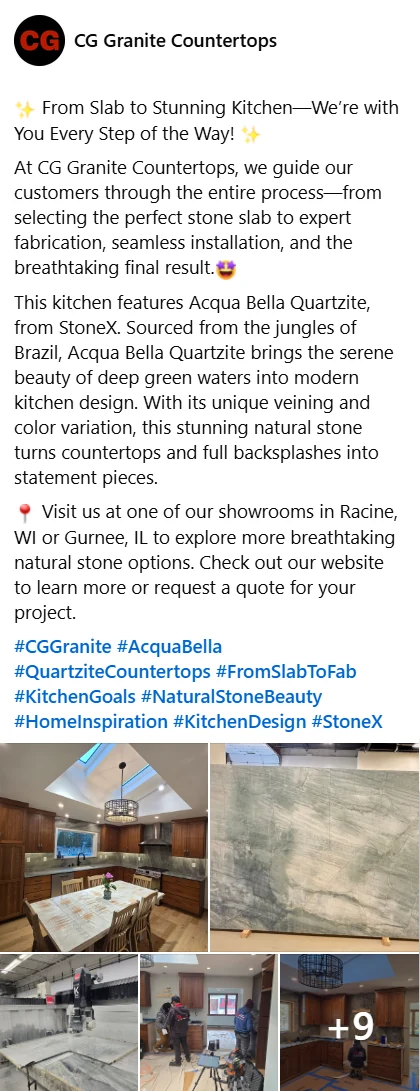
Social posts built for proof, presence and search
Every finished kitchen is proof of the work. These posts share it on Facebook, Instagram and both Google Business Profiles, so the client stays top of mind with past customers and shows up when new ones search. Facebook posts and videos can appear in Google results too, so each post works in more than one place. ChatGPT wrote the first drafts, and I edited each one in the client’s voice. Before posting their photos, I fixed the lighting and straightened crooked angles in Canva.
ToolsHighLevel · ChatGPT · Canva · Facebook · Instagram · Google Business Profile
Certifications
- Career Essentials in Generative AI Microsoft & LinkedIn (2026)
- HubSpot Inbound Marketing
- HubSpot Marketing & Content Hub Software
- Google Analytics (GA4)
About
How I work. What I bring.
I say what I’ll do, and what I won’t.
When a client’s website had technical problems outside my skills, I told them plainly and recommended bringing in a developer. It wasn’t an easy conversation, but it was the honest one.
I start with the customer.
Selling jewelry taught me to listen first. Product development and digital marketing taught me to start with the client’s ideal customer and their journey, because what I’d choose matters less than what makes that customer say yes.
I question the status quo, then test a better way.
Short-form video was taking off on Facebook, Instagram, and YouTube, but the client was posting mostly photos and a few long horizontal videos. I recommended shifting toward Reels, Stories, and Shorts while keeping photos in the mix, and their first YouTube Short passed 15,000 views.
I check the details.
Before anything goes live, I check every name, number, and link. Small mistakes cost trust, and trust is what I’m building.
Jessica was good at identifying the problem and coming up with possible resolutions… She was very good at putting her thoughts together and at maintaining a paper trail for quick follow up.
When I’m not working
On a nice day, you’ll find me walking the lakefront or on my deck with a good book. I read a little of everything, from the financial markets and technology to classic novels and the power of mindset. Otherwise, I’m at the gym, spending time with family, or spoiling my two cats (who already think they own the place).
My process
How I work with AI. Context, rules, review.
AI speeds up my work, but I stay in charge of the thinking, the voice, and the final call. Here’s how I keep AI-assisted work accurate and on-brand.
-
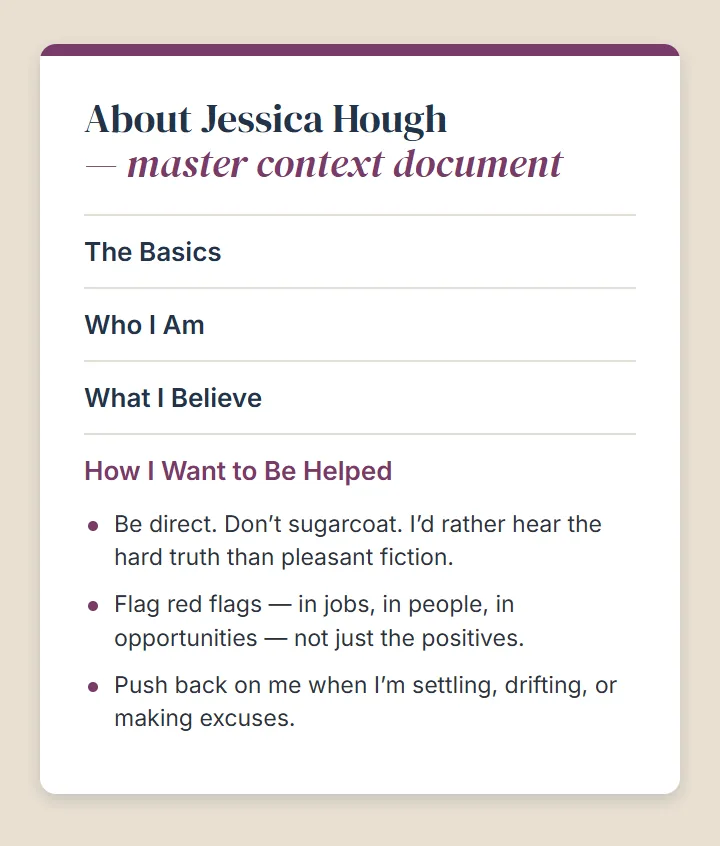
Give it context.
Every project starts with a master “About me” document and project instructions, so each chat already knows my goals and how I want to be helped.
-
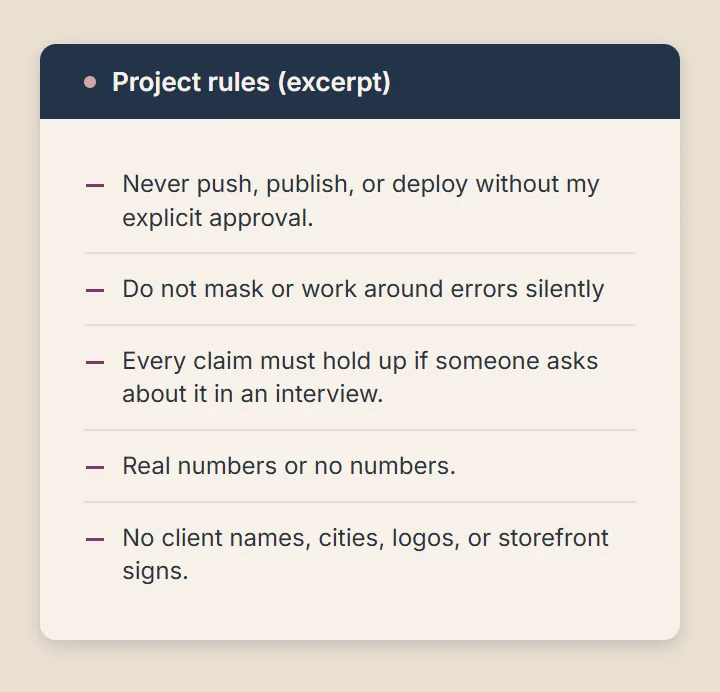
Write the rules.
I give Claude Code written rules for accuracy and privacy, like never claiming results I can’t explain and never publishing without my approval.
-
Review everything.
I check every word, link, and number at phone and desktop sizes before anything goes live.
My AI toolkit
- AI search testingI test how businesses show up in ChatGPT, Gemini, Perplexity, and Google AI Mode.
- ClaudeProjects with my context and instructions, connected tools for research and data, and repeatable workflows, including my AI visibility audit process and a LinkedIn content system built around my brand voice.
- Claude CodeBuilt this website and my True Cost Calculator, under written rules for accuracy and privacy.
- ChatGPTBrainstorming and refining my audit process alongside Claude, and image concepts I finish in Canva.
- GeminiImage concepts I finish in Canva, and podcast-style audio with Gemini Notebook (formerly NotebookLM).
- PerplexityResearching which tools are available to small and local businesses today.